Cleveland Neighborhood Progress funding isn’t flashy, but vital to success of local CDCs
CNP grants
- Burten, Bell, Carr Development: $160,000
- Famicos Foundation: $165,000
- Greater Collinwood Development: $97,200
- Harvard Community Services Center: $10,000
- Jefferson-Puritas West Park CDC: $135,000
- Little Italy Redevelopment: $10,000
- Metro West Community Development: $165,000
- MidTown Cleveland: $152,000
- Northwest Neighborhoods CDC: $84,500
- NuPoint CDC: $109,200
- Ohio City Inc.: $30,000
- Old Brooklyn CDC: $84,500
- Slavic Village Development: $84,500
- St. Clair Superior Development: $218,000
- Tremont West Development: $56,600
- University Circle, Inc.: $10,000
- West Park Kamm’s Neighborhood Development: $55,000
- Westown CDC: $32,500
Ask 10 people what role a community development corporation (CDC) plays in their district, and you’re likely to get 10 different answers. A $1.66 million investment from Cleveland Neighborhood Progress—the funding intermediary for the city’s neighborhood-based development groups—should bring more transparency and understanding to this work, says Jason Powers, senior vice president of CDC advancement with Cleveland Neighborhood Progress (CNP).
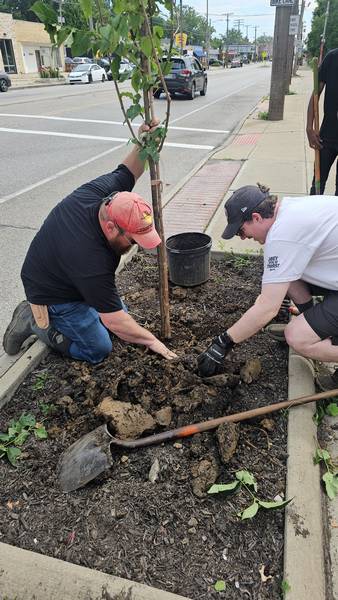
 Cleveland Neighborhood Progress dollars support local development initiatives such as tree plantings and storefront renovations.“The grant awards are responsive to the diverse programs and operations of each CDC,” explains Powers. “They support the work of community development, which shares core functions across the city while also being tailored to each neighborhood’s specific needs. Flexible funding allows CDCs to remain focused on those core functions and deliver better outcomes for their distinct neighborhoods.”
CNP announced the funding in June and began distributing the grants among Cleveland’s 18 CDCs on July 1. The award is also a feature of a CNP “advancement model,” a framework that guides both funding and organizational support focused on community engagement, development, planning, marketing, and partnering.
Additionally, the model provides a roadmap for resource allocation, replacing a process that was sometimes opaque and poorly understood, adds Powers.
The new approach is intended to make funding more strategic while giving CDCs greater flexibility to respond to neighborhood priorities.
CNP president and CEO Tania Menesse said these dollars will smooth the pathway between a neighborhood’s needs and a local CDC’s response.
“We believe that development in Cleveland neighborhoods should center residents’ voices and hopes for their communities,” Menesse said in a press release. “Through these investments, we build resilient organizations and position them to shepherd long-term improvements and growth.”
CNP grant and capacity-building derives from Cleveland Foundation, among other regional funders. Officials say these dollars will support revitalization of “opportunity neighborhoods” commonly targeted for small business grants, housing development, and land revitalization.
CNP grants are intended to strengthen organizational health, including stronger investment in human capital. What’s more, the dollars will plug holes in areas such as finance, technology, human resources, and governance. While operational support might not sound exciting, it remains vital to a CDC’s day-to-day operations, Powers says.
The opportunity neighborhoods—which include Fairfax, Kinsman, and Slavic Village—often receive priority in municipal funding.
Though Cleveland’s CDCs are crucial to neighborhood upkeep, many rely on part-time staff who are juggling multiple projects. The issue is compounded by COVID-driven inflation that lured executive talent to more lucrative industries.
“Funding these internal, systems-oriented things is not getting someone’s house painted, but will let the CDC take that program to the next level,” Powers says. “CDCs are the last mile of these programs getting to residents. They’re also the first mile when a business is trying to open, even before talking to a city.”
Because neighborhood development depends on healthy CDCs, this latest funding serves as a reminder of their importance. If CDCs are to be architects of neighborhood success, then they should also be treated as such, says Powers.
“CNP’s goal for this program isn’t sexy or marquee,” he says, “but it will keep organizations across the city functioning in ways to provide residents and businesses the services they need.”