
Falling in love with trees this autumn: Cleveland Tree Plan marks its 10th anniversary
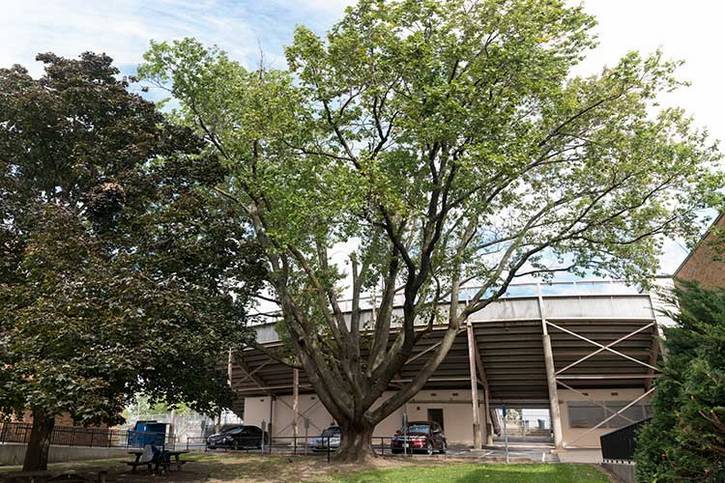


Hear the words “autumn” and “tree,” and most people think of colorful fall leaves. But it may be a surprise that autumn is, in fact, the best time to think about new trees. In other words, planting new trees.
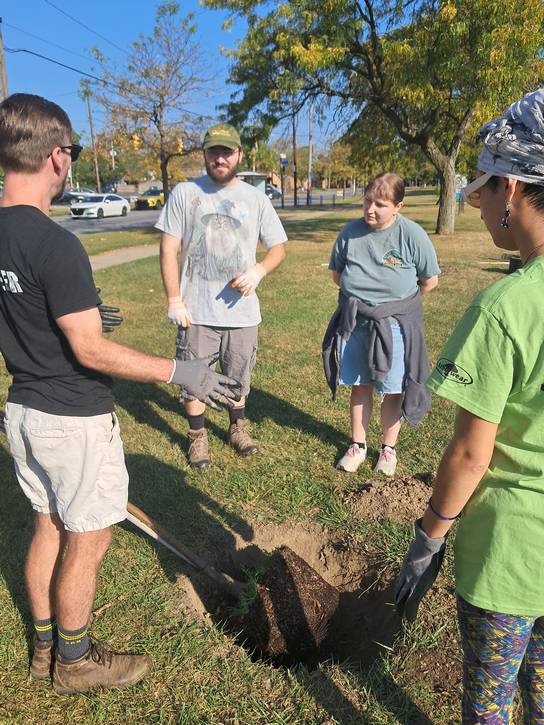
 WPKND Tree Stewards at the newly installed CMHA Riverside. planting site.Ever since the Cleveland Tree Plan (CTP) was drafted 10 years ago by what was then the newly formed Cleveland Tree Coalition, residents, neighbors, conservation groups, and urban foresters have been planting trees in Cleveland’s urban neighborhoods and across Northeast Ohio.
Even though they’ve been active, many more trees need to be planted if Cleveland hopes to reclaim its Forest City title and achieve the Tree Plan’s goal of attaining a 30% tree canopy coverage by 2040.
In 2021, Freshwater Cleveland first introduced Holden Forest & Garden’s launch of its People for Trees program. The article outlined the CTP and detailed progress reports on the decline of the region’s urban tree canopy.
While nearly every Tree Coalition member shared their progress reports with similar stats, People for Trees representatives say they had hoped to achieve intangible results—inspiring a new love of trees in the public.
As leaders at Holden Forests & Gardens said in 2021, “Reforesting Cleveland needs everyone’s support.”
Heights Tree People founder and Collinwood resident Laura Marks is one of the new appointees in Cleveland’s revived Urban Forestry Commission.
 OBCDC Tree Stewards demonstrate how to properly plant trees to residents at Estabrook Rec Center.Healing from past neglect
Marks describes how Cleveland Mayor Justin Bibb’s administration is stepping up tree canopy preservation efforts—including creating an inventory of all city-managed trees by Davey Resource Group. She says measuring the tree inventory is critical.
“As I drive in Collinwood, I see a whole lot of trees that are dead,” she explains. “If planting a tree gives you that sense of hope, seeing a tree that is dead—I think it is worse than an empty space.
“It says to me, there is disinterest and neglect,” she continues. “I want to get the dead trees removed as soon as possible.”
A history of disinterest and neglect is evident in 2018 maps and data indicating canopy coverage in Cleveland. While the city’s overall coverage in 2018 was 18%, some areas were at a staggeringly low 3%.
Representatives from Western Reserve Land Conservancy (WRLC) explain the canopy decline is the result of decades of disinvestment in many Cleveland neighborhoods through intentional policy decisions.
The representatives say that some areas experience higher tree loss from aging infrastructure, disease, and development, yet these neighborhoods also receive fewer resources for tree replanting and maintenance.
On a recent pleasant fall evening, WRLC staff and volunteers greeted eager Clevelanders in one such historically overlooked neighborhood— the St. Clair-Superior neighborhood—at the Slovenian National Hall on East 63rd Street and St. Clair Avenue.
Volunteers lined up their cars behind the Hall for WRLC’s Fall 2025 Trees4Cle Delivery Day, where workers helped them load free trees and planting supplies.
The annual giveaway is just one of the ways WRLC is working to heal past tree neglect.
“We partner with residents and community groups to plant and care for trees where they are needed most—often in neighborhoods with the lowest canopies, highest heat vulnerability, and greatest health challenges,” explains Tom Schreiber, WRLC senior manager of community forestry. “Our program also trains and supports local leaders through the Sherwick Tree Steward Training program, which empowers people to advocate for trees in their own neighborhoods through engaging sessions and hands-on training.”
The tree stewards of Cleveland’s west side
Residents from Old Brooklyn learned firsthand why tree education matters on a not-so-fall-like Saturday morning at Estabrook Recreation Center, where the Old Brooklyn Tree Stewards (OB Tree Stewards) demonstrated how to properly plant trees while they also replaced three dead trees.
“Thank you for planting trees!” a voice yells out of a passing car. Nearby, volunteers sweat as they dug holes under full sun. It will be a few years before the new trees offer much needed shady relief.
The OB Tree Steward Program is the brainchild of Old Brooklyn Community Development Corporation (OBCDC) community engagement manager Hope Fierro. The concept is a success story about the value of local, community-managed programs.
 Taking a break after tree planting.Rather than relying on weather or volunteers to water more than 100 trees planted by OBCDC across three parks, Fierro included grant-funded, paid positions into her program. Now in its fourth year, Fierro’s team includes 10 paid local stewards and a coordinator who manage park trees and support resident plantings offered through OBCDC.
Fierro’s successful approach is contagious. With her guidance, West Park Kamm’s Neighborhood Development (WPKND) created its own tree steward team in 2024.
If trees are a symbol of hope, Emily Pikturna, neighborhood engagement coordinator at WPKND, recognizes the importance of protecting that symbol. Her organization teamed up with Cleveland Metropolitan Housing Authority’s Riverside Park as part of its priority to serve neighborhoods with greater social inequities.
“It’s really easy to plant the tree and walk away,” Pikturna explains. “Having people that are on-site every week, [who] are watering the trees, [who] are caring for the trees—that’s really valuable. Especially at Riverside, where there are still those historical wounds and distrust [in WPKND].”
Pikturna says she hopes the tree stewards can foster growth in people living at Riverside as much as its trees. She might not have to hold out hope much longer. Earlier this summer, the first Riverside resident joined her team—evidence engagement through trees is working.
That growth isn’t limited to one age either. Steward efforts at Riverside have inspired children living there. Pikturna witnessed how a day planned to simply replace dead trees transformed into an impromptu youth education event.
“It was a weekday evening, and we just happened to find the perfect time when all the kids were out playing.”
Suddenly they were surrounded by eager children wanting to get involved.
“We’re having literally 15 kids helping dig holes and prepare trees, put them in the ground, showing them the roots of the tree,” Pikturna recalls. “It was a little chaotic, but it was really rewarding in creating community.”
Pikturna says she overheard one of the kids say, “Oh, I wanna do this when I’m older,” and says she watched another boy hug the tree he had just helped to plant before proclaiming, “This is my tree friend.”
Holden Forest & Garden arborists behind People For Trees would be pleased to hear that.
WPKND Tree Stewards at the newly installed CMHA Riverside. planting site.Looking for resources
Community development corporations like Old Brooklyn CDC and West Park Kamm’s Corners CDC say they are fortunate to have people with experience and knowledge to acquire reforestation resources.
But, as Heights Tree People’s Marks points out, sometimes this makes it harder for neighborhoods like Collinwood, which don’t have CDCs.
So, what is Marks’ advice for people in those communities trying to advocate for more trees where they live?
“I would go to the WRLC,” she advises. “I would search out local tree stewards, to find out ways [to get involved]. Call your city councilperson. Keep asking the question at every institution you have connection with.”
As additional trees are planted this fall, Greater Cleveland is one step closer to reclaiming its title as the Forest City. Because everyone deserves their own tree friend.
