Still Standing: BH General Contracting gives a 126-year-old Bedford home a new lease on life





 A bright, remodeled kitchen.The grand homes of Cleveland’s wealthy are justly renowned, but the homes of the legion of blue-collar workers whose diligent labor made those fortunes possible deserve recognition too.
One such century home stands on East Grace Street in Bedford—known as “Hometown America at its best” with older, well-maintained homes on tree-lined streets, locally owned shops, a Town Square with a gazebo, and plenty of outdoor activities in the Cleveland Metroparks Bedford Reservation.
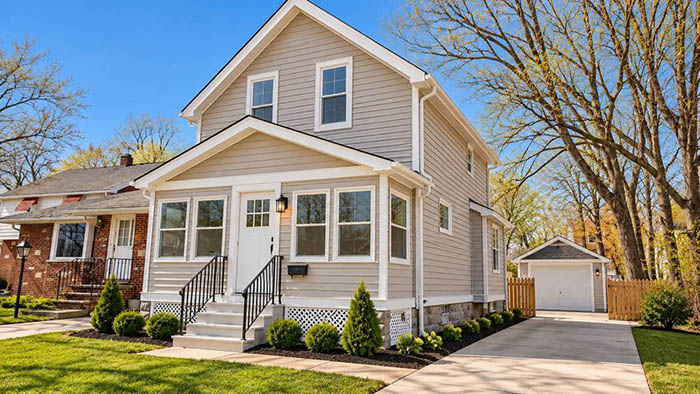
The Grace Street house was built in 1900 in the American Foursquare and Colonial architectural styles. The two-bedroom, one-bath house is not quite a tiny house, but its 956 square feet of living space doesn’t qualify as a large house by any means.
Nick Bat, owner of BH General Contracting, a Shaker Heights-based full-service remodeling company that handles everything from kitchen and bathroom remodels to whole-house renovations, says he and his crew concentrate on older homes in Northeast Ohio.
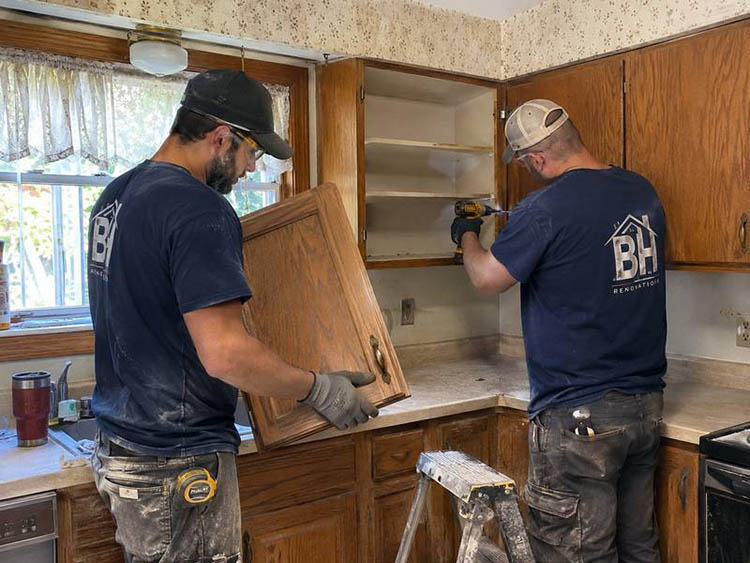
 BH General Contracting employees work on a kitchen remodel.“We especially focus on century homes, which is most of what stands in this part of Northeast Ohio,” says Bat. “We serve Cuyahoga County and the surrounding counties.”
The little East Grace Street house is an example of the types of renovation projects Bat jumps on.
“An old house has a character you can either keep or erase, and erasing it is always the cheaper option,” he explains, adding that keeping the Grace Street house was the sensible option.
"The character of this house is modesty—done well,” Bat says. “There's nothing decorative about the house—no grand entry, no wasted space. But the house was built properly with solid framing, good proportions, and every room sized for how people actually lived.”
Bat says what the East Grace house says about Bedford at the turn of the 20th century is that it was a place where an ordinary working family could own something solid.
“What it says now is that whoever built it built it well enough to still be worth saving 120 years later,” he explains. “That isn't true of everything from that era—most of it is gone."
A house that stands the test of time
Bat and his BH General Contracting team began renovations on the East Grace Street house earlier this year, in April. He says the intention was to preserve its history while also updating it for the 21st Century.
“We chose to keep what makes the house what it is—instead of gutting it and handing back a house that could be anywhere,” he explains. “It takes longer and it costs more—but when it's done it's still a turn-of-the-century house, just one that works for a family today.”
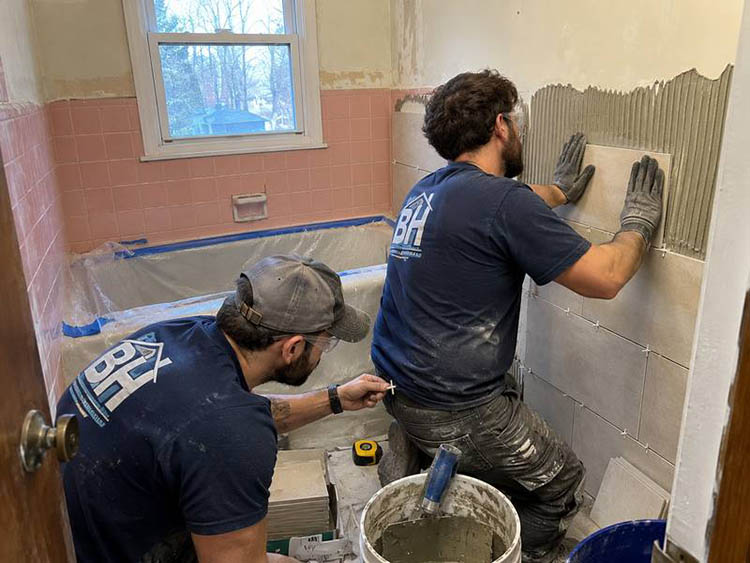
 BH General Contracting employees work on a bathroom remodel.Most of Bedford’s housing today consists of homes built during the post-World War II suburban boom of the 1950s and 1960s, Bat says. He adds that a large segment of Bedford's oldest neighborhoods feature homes that date back to 1900 or earlier—like the house on East Grace Street.
“It’s a small footprint on a small lot—it was built close to the street and had no garage because nobody had a car,” says Bat, who explains it’s the type of house built for someone who was employed in the neighborhood and walked to work
“People came to places like Bedford because there was work, and because a working family could actually own the house they lived in,” he says. “That combination wasn't available to them everywhere."
Additionally, Bat admits the house made him a bit nostalgic when he first saw it.
“I'm not originally from Cleveland, but my grandfather lived here in the 1950s,” he says. “The city isn't new to my family, even though I came here from somewhere else. Houses like this one were already half a century old when my grandfather was here."
Bedford’s early history
The first settlers arrived in 1813 to what became the village of Bedford in 1823. The village became well-known for its anti-slavery stance and became a stop on the Underground Railroad after Julius Caesar Tibbs, who was born into slavery in Virginia in 1812, escaped and made his way to the Burns Farm in Bedford.
By the early 1900s, Bedford transitioned from a quiet, rural village into a growing manufacturing, industrial, and commercial community.
The growth, in part, was due to the village’s Wheeling & Lake Erie train depot—which also facilitated President-elect Abraham Lincoln’s 1861 stop in Bedford while traveling by rail to Washington, D.C. for his inauguration.
Bedford housing and industry
Bedford homes, like the East Grace Street house, were mostly built around the turn of the 20th century. The housing stock includes Victorian, Queen Anne, Colonial, and early American Foursquare architecture—often featuring steep gabled roofs, spacious front porches, narrow footprints, and detached carriage houses (later converted into garages).
 The renovated living and dining room in the 1900 East Grace house.The timber-framed structures relied heavily on locally produced lumber from active mills powered by nearby Tinkers Creek. Most surviving residential and commercial buildings from this era are preserved within the Bedford Historic District, centered around Broadway Avenue.
As early as 1815, the waterpower of the Tinkers Creek falls was tapped for everything from manufacturing to milling flour, timber, cider, and textiles.
Well over a century old now, the East Grace Street house shows all the earmarks of a house that began its life as an early 20th century workman’s cottage.
Bat was immediately drawn to the old white house that showed its age.
“That it's still here, and that it still shows its age honestly,” Bat explains of why he wanted to renovate the Grace Street home. “The coal chute in the foundation wall, the shadow of the old wiring, the proportions of the rooms—those things are the house's memory.”
Bat set out to bring it back to its original glory. “You can erase all of it in a week with a sledgehammer,” he says of the house showing its age and the renovations. “Then you have a new house inside an old shell. I'd rather the house still look like itself."
Bedford’s housing stock in 1900 consisted of approximately 300 to 400 structures, as the community was still a small, rural township and village with a population of about 1,500, transitioning into a manufacturing hub—with companies like Bedford Roller Mill, Taylor Chair, B. L. Marble Chair Co., and McMyler-Interstate Co., among others.
Designs of the times
The East Grace house has a coal chute in a foundation wall—something once seen in practically every Cleveland home but has been obsolete for almost three-quarters of a century now. These coal chutes led to basement coal bins where fuel was stored to keep hand-fired furnaces running through the harsh Northeast Ohio winters.
Almost certainly constructed without electricity, the house shows evidence of the installation of knob and tube wiring—state-of-the-art a century ago but now as obsolete as the horse cavalry.
 The plumbing was constructed of cast iron pipes with joints sealed with lead—something else that would never pass muster today because of the health risks associated with lead exposure.
Bat and his team replaced all of the outdated systems.
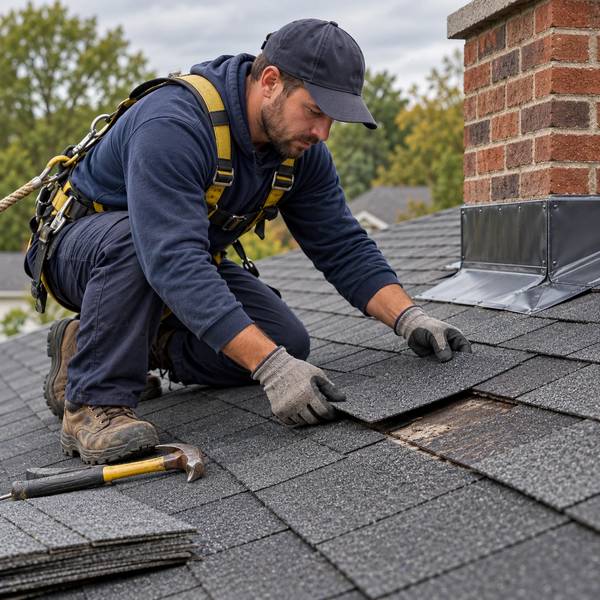
“The knob and tube is gone and replaced with new electrical wiring; the lead-sealed cast iron is gone and there’s new plumbing,” he says. “There’s new heating, new insulation, new windows, a new roof, new gutters, a new kitchen, a new bath, and new floors,” he says.
“What isn’t new is the house. Same framing, same proportions, same rooms, same footprint—that was the whole point.”
If walls could talk
The East Grace Street house is a remarkable survivor. The house and those who lived in it would have seen the aftermath of the Spanish American War, the assassination of President William McKinley, World War I, the Spanish Influenza Epidemic, the Great Depression, World War II and the assassination of President John F. Kennedy. Its owners would have watched with amazement as men walked on the moon in July 1969.
The house would have witnessed all the other milestones of everyday life: births, deaths, and everything in between.
A home’s renaissance
The East Grace house saw the arrival of a large population of Black residents to the neighborhood, who came to the area during the Great Migration from the 1910s to 1930s to escape oppression in the South and to seek better lives.
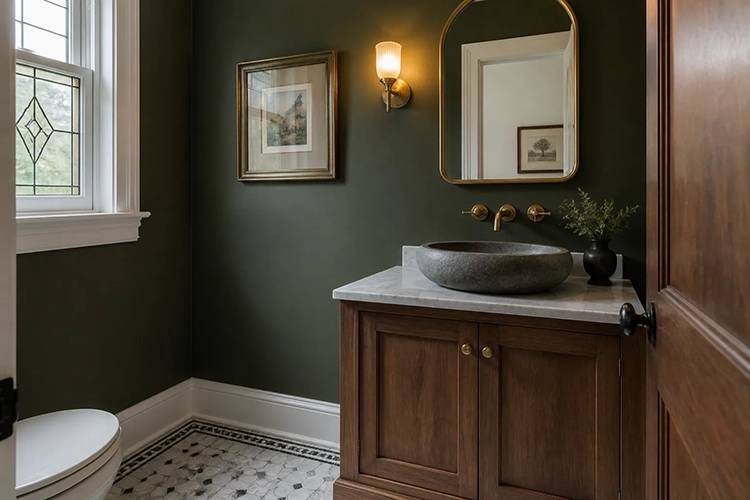
 A remodeled powder room done by BH General ContractingThe house’s rebirth began after a long interval when the house stood empty.
Most of the issues encountered in the renovation were to be expected. Systems had to be updated to meet modern standards. Most of the usual suspects were encountered in obsolete plumbing and wiring and primitive insulation—while “handyman” repairs and modifications made over the years added several curveballs.
But the biggest challenge wasn’t as routine, Bat says.
“We found an antique safe in the house, anchored deep into the ground—not bolted to a floor, set into the earth itself,” he recalls. “There was no lifting it out in one piece and no way to work around it.”
Bat says they were determined to get the thing out of the ground. But it was quite a task.
“So we drilled it, over and over, until it came apart,” he says. “Then we carried it out in pieces. It took longer than anything else on the job, and there was nothing clever about it—just persistence.”
After all that work, Bat says the safe was empty—just a big empty box.
Despite what people may think, Bat says an in-ground safe does not add to the house’s character.
“The coal chute is character,” he says, “the safe was in the way.”
Respecting the neighborhood
The presences of two churches near the 126-year-old East Grace house were a sign to Bat that this was a good project to take on.
 The renovated kitchen in the 1900 East Grace house.“Two churches directly across the street tell you what kind of block this was,” he observes. “People put down roots here and built institutions. That isn't a place you pass through.”
Bat says the BH General Contracting team made sure to respect both the East Grace Street residents and the churchgoers.
“The days the block is at its quietest are exactly the days we'd normally be at our loudest—so we built our schedule around them,” he says, adding that respect for the residents and the community is always a priority in their remodeling and renovation projects.
“Demolition and saw-work was done on weekdays, and the sidewalk and street were kept clear on service days,” Bat notes. “You don't learn that off a set of plans—you learn it by standing on the street and paying attention to who else is using it."
The finished product
Five months after beginning work on the 126-year-old East Grace Street house, Bat reflects on the work he and his team did.
“People assume the hard part of an old house is the big stuff—the roof, the wiring, the plumbing—it isn’t,” says Bat. “All of that is just work: You plan it, you budget it, you do it. The hard part is whatever nobody put on the plans. In this house, that was a safe in the ground.”
Bat says his original intent was to stabilize the home, make it structurally sound, and make it suitable for occupancy for at least another 50 years. He accomplished that mission.
He notes that he was pleased once the project was completed in August.
“Relief first, honestly—then something quieter,” Bat describes his emotions when he completes a big renovation project. “You stand in a house that sat empty and dark for years, and the lights are on, the floors are level, the heat works—and somebody is going to live there.
“You didn't build it, somebody did that 120 years ago,” Bat continues. “But you're the reason it gets another fifty years. That's a good thing to go home with.”
 Bat recently leased the East Grace Street house to new tenants, who are now writing the next chapter of its long and colorful history.
Nick Bat owns BH General Contracting, LLC, which is a Shaker Heights-based remodeling and renovation company serving Cuyahoga County and the surrounding counties. BH General Contracting specializes in breathing new life into older homes, updating essential systems and structures while preserving the character and craftsmanship that make them unique.