
America at 250, Cleveland at 230: Shared stories of growth and resilience


As America celebrates a milestone semiquincentennial birthday this July 4, 2026, we should remember Cleveland’s role in this extraordinary story.
 Hollenden Hotel at Superior Ave. and E. 6th St. 1906Only 20 years younger than the country itself, Cleveland has witnessed nearly the entire story of America firsthand. From serving as an early 19th century frontier outpost, the city of Cleveland transitioned to a center of banking and finance and became an industrial powerhouse by the turn of the 20th century.
It was an incredible transformation—growing from a handful of cabins to building Millionaire’s Row in less than 100 years.
The early families with New England roots were joined by a huge influx of immigrants from Europe. Black Americans, seeking to distance themselves from ill treatment in the south, arrived in large numbers and helped build Cleveland—from day laborers to the inventions of Garrett Morgan and every job in between.
Industrialist John D. Rockefeller began work as a teenage clerk for Hewitt & Tuttle in the Flats. By middle age, his Standard Oil Company had made him the richest man in America by a considerable margin.
Many fortunes were made here. Cleveland was said to have the largest population of millionaires to be found anywhere in the world.
Cleveland became a center of healthcare with institutions like Lakeside Hospital, the Cleveland Clinic, University Hospitals, and the Frances Payne Bolton School of Nursing.
Educational institutions thrived here. St. Ignatius High School, Case Institute of Technology, and Western Reserve University laid the foundation for many careers in education and the professions. They had plenty of competition.
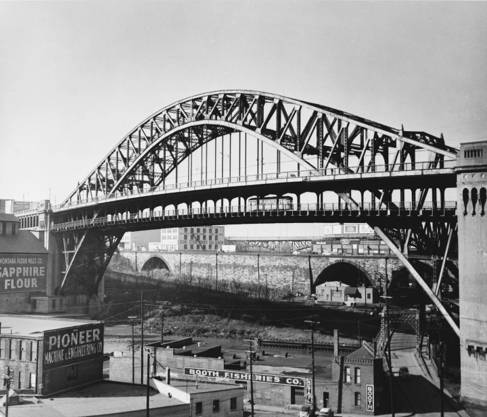
 Veterans Memorial Bridge pictured in front of the Superior Viaduct.Cleveland sports teams rose to the top. The Cleveland Indians won the World Series twice, in 1920, and 1948.
The Cleveland Rams won a league championship in 1945 and paved the way for a number of exciting Cleveland Browns teams, including the 1964 Championship winners.
Cleveland was a transportation hub, with the Cleveland Municipal Airport that was established in 1925 (today’s Cleveland Hopkins International Airport).
Just four years later, the airport hosted the National Air Races for the first time. The racing pilots became folk heroes. Everyone knew Roscoe Turner (and his lion cub Gilmore!), Jimmy Doolittle, Harold Neumann, and Benny Howard.
With the city in the grip of the depression the races routinely drew daily crowds of 100,000.
The event continued until 1949.
Cleveland claimed world class museums as early as 1916 with the creation of the Cleveland Museum of Art.
Brave Clevelanders fought in all the nation’s wars. They are commemorated in the Soldiers and Sailors Monument and the Cleveland Grays Armory.
The 20th century saw extremes, with the city riding high in the 1920s and then brought low by the Great Depression. The economy recovered due to war production for WWII.
The city reached its maximum population in 1950, exceeding 900,000 people.
This booming population wasn’t destined to last, with flight to the suburbs reducing the population dramatically by the end of the century.
Things began to improve with events like the Cleveland Cavaliers winning an NBA Championship in 2016.
Undaunted, Browns fans continued to hope for the best.
The gritty industrial city is largely a thing of the past. Cleveland relies on an economy based on service work and healthcare monoliths.
There is no telling what the future holds as we look forward to the next milestone birthday.
About the Author: Tom Matowitz
Recently retired after a 37-year career teaching public speaking, Tom Matowitz has had a lifelong interest in local and regional history. Working as a freelance author for the past 20 years he has written a number of books and articles about Cleveland’s past. He has a particular interest in the area’s rich architectural history.