Doomed to repeat: Forthcoming ‘Derf’ book illustrates a century-old war on free speech

“History does not repeat itself, but it rhymes” is a remark often credited to humorist and writer Mark Twain, although the attribution remains clouded by time.
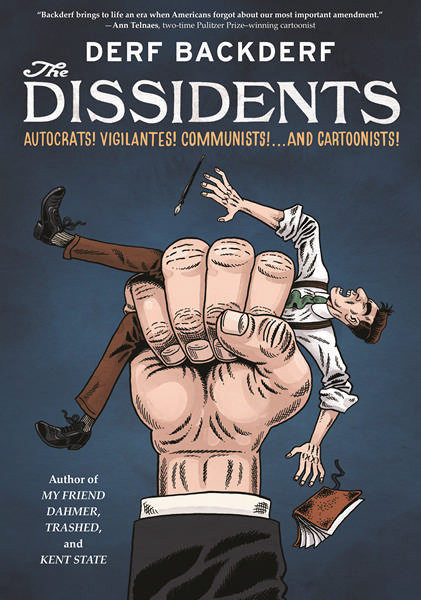
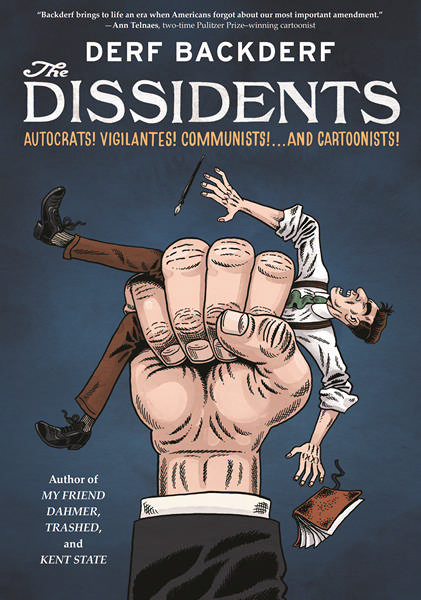 'The Dissidents' coverThat sense of history echoing across generations is at the heart of “The Dissidents,” the newest graphic novel from Cleveland author John “Derf” Backderf.
Whatever its origin, the truth of this statement resonates throughout “The Dissiddents.” Slated for a September release, the book chronicles the true story of political cartoonists and journalists enduring under the poisonous gaze of authoritarianism.
Artists at the “radical” magazine “The Masses” faced blacklisting and prison for opposing President Woodrow Wilson as he marched the nation into World War I. Themes of free speech, political violence, and rising white supremacy serve as a grim reflection of our current political landscape, Backderf said in an interview with FreshWater.
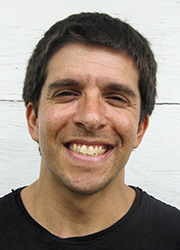
“It’s a mirror to society, and I of course recognized that,” says Backderf, the Richfield-raised author of My Friend Dahmer and Kent State. “It started on the path with Trump and got me thinking of The Masses as a topic for a graphic novel. We are in the same spot as a century ago. I thought this would be relevant much like the Kent State [book]—depressingly so.”
Launched in 1911, The Masses’ revolutionary politics and modernist aesthetics earned it the distinction of “the most dangerous magazine in America.”
Artists such as Art Young, Cornelia Barns, and Bob Minor championed the era’s progressive causes—from women’s voting rights to the fight against destructive labor practices.
While The Masses’ socialist and left-leaning ideas sparked the occasional arrest, real trouble arrived when the U.S. entered the First World War. Seeking to curb dissent from Congress and the public alike, the Wilson administration enacted the Espionage Act, granting the government power to crush opposing speech.
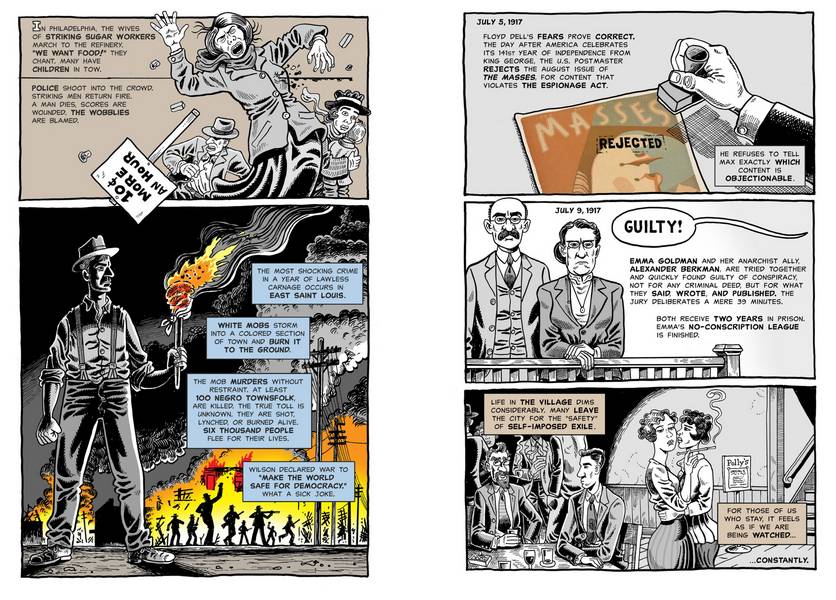
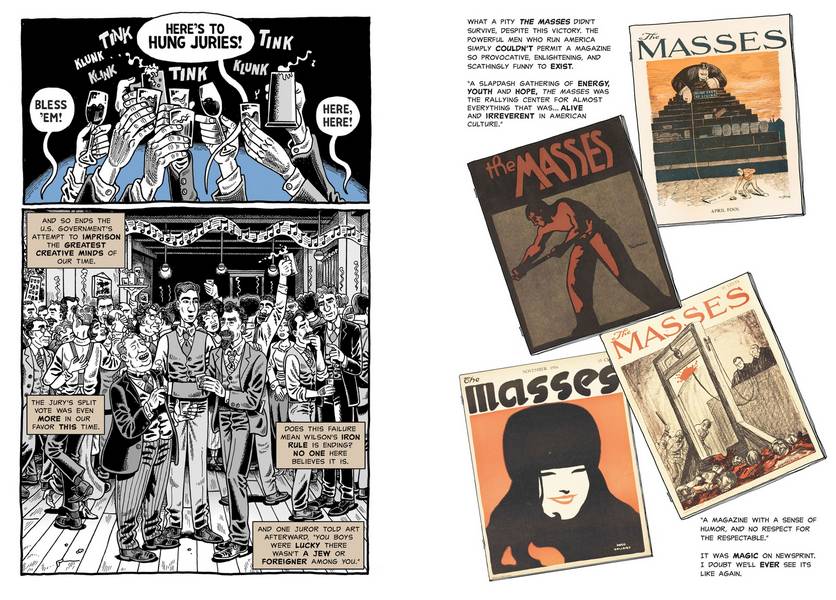
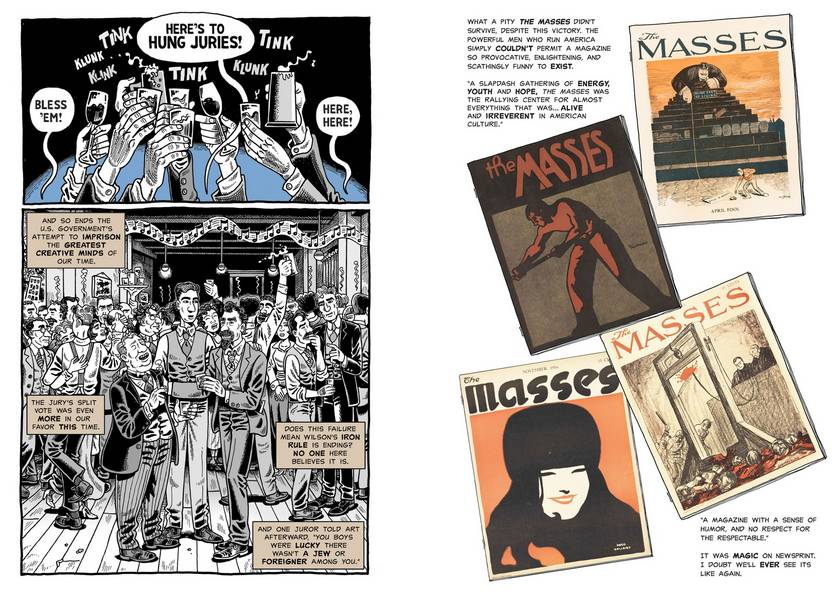 An excerpt from 'The Dissidents.The legislation prohibited interference with military operations or recruitment, including any anti-war sentiment in word or deed. The Espionage Act also empowered the postmaster general to halt any publication the government deemed “treasonous.”
The Masses became an easy target for authorities—an August 1917 issue was specifically cited for subversive drawings of a cracked Liberty Bell along with a cartoon entitled “Conscription,” which depicted nude corpses lashed to a cannon.
Unable to ship copies to subscribers, the magazine folded in late 1917. Some of its staff started a new publication called “The Liberator” and soon found themselves in court for “obstruct[ing] the recruiting and enlistment” of the military. Although the case ended in mistrial, the chilling of free speech had achieved its misbegotten goal—former cartoonists for The Masses penned patriotic cartoons just to keep working, or they fled the country altogether.
Backderf has no intention of painting these men and women as flawless heroes, he says. Rather, he wants to shed light on a largely forgotten chapter of American history.
“Perfect heroes are boring, and people have flaws,” he says. “I’m not expecting to change people’s mind with this book. The goal is to tell a great story and [we] hope to stop repeating the same sorry history.”
A challenging project
Backderf discovered “The Masses” as a student at The Ohio State University, where he himself dabbled in political cartooning. The budding artist was inspired by the magazine’s aesthetic variety as well as its contributors’ rebellion in the face of power.
In “The Dissidents” Backderf tells the story of Joe Hertle, a young cartoonist who tires of churning out puzzles for daily newspapers. Spellbound by the provocative output of “The Masses,” Hertle moves to New York to chase a dream that is not quite what it seems.
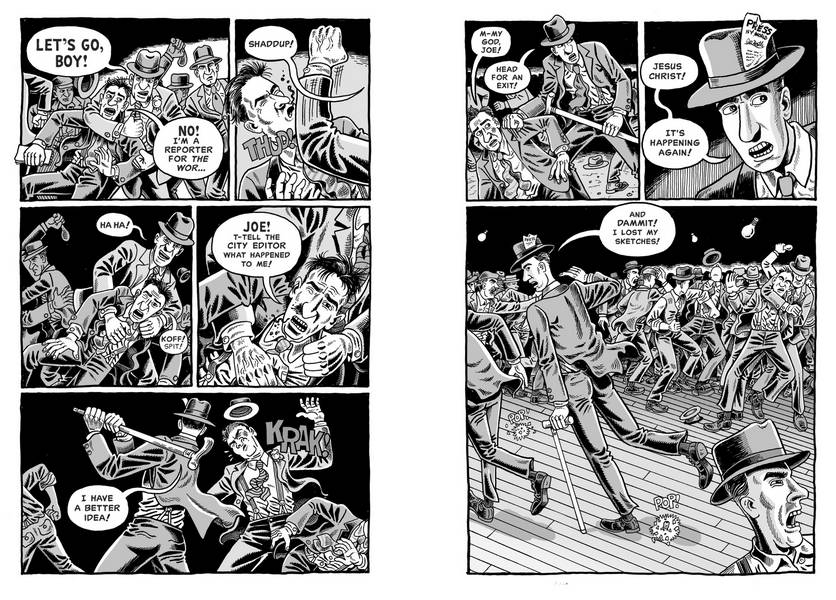
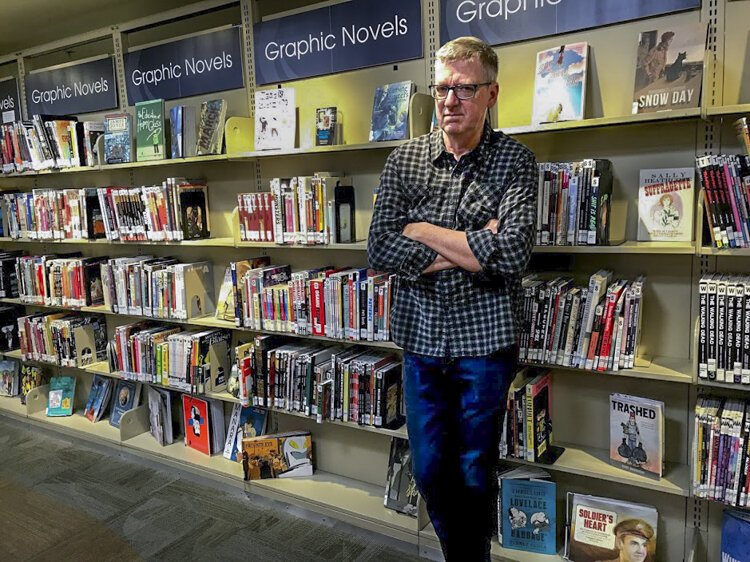
 John Backderf knows graphic novels.Through the eyes of Hertle—a fictional protagonist born to German immigrants—Backderf explores the effects of the country’s burgeoning nativism and xenophobia. Street-level terror becomes a mandate via the American Protective League, an officially sanctioned vigilante group that targeted draft dodgers and anti-war protestors.
“I needed a narrator, and [Hertle] allowed me to work in the immigrant experience more than I could have otherwise,” says Backderf, himself of German ancestry. “He provides context and shows why these cartoons had such an impact.”
Spanning nearly 300 pages, “The Dissidents” is richly detailed with period-accurate fashion and architecture. Dense historical detail is punctuated by sudden splashes of color, like the vivid red of blood on a World War I battlefield.
The book took over three years to research, write, and illustrate, representing what Backderf says is one of the most challenging projects of his career. Unlike the Kent State book—where Backderf had living subjects to interview—"The Dissidents” required a deep dive into hard-to-find archival material.
“This was a tough book to do,” says Backderf. “I liked tracking down the cartoons, even finding some of the originals. Holding these cartoons in your hands is a real geeky thrill for any comics person.
“Political cartoons just fade like the daily news, unlike comic strips or graphic novels,” he continues. “Some of them are hard to decipher, but you know in their day, and in that moment, that they were powerful.”
Ultimately, Backderf says he wants readers to know that our recent era is not the first time the government has enabled America’s worst and ugliest impulses.
“It’s certainly a warning from the past, but I’m not preaching anything here,” Backderf says. “I’d say we’re already too late on not repeating the outrages of 1917.”