
Search results for 'statue entertainer worked for media outlet near auctioneer jeweler rehab center'

"Not your average flea market, this pop-up event serves as a business incubator for small businesses and has helped spur development in the neighborhoods where it's held."
Read the full story here.
Read the full story here.


"Chateau Hough, one of the first American vineyards set on reclaimed urban land, was started in 2010 with a $15,000 grant from the city and about $8,000 of Frazier’s own cash. Frazier’s main objectives were to beautify the lot across from his house (hopefully raising its value) and help out parolees, who often have trouble finding work. But he also wanted to see if Cleveland’s most notorious neighborhood could maybe make a pretty damn good wine."
Read the full story here.
Read the full story here.


Cleveland's knowledge-driven "eds and meds" sector, which stands 11th nationwide in total employment, is a major factor in luring high-skilled immigrants to the North Coast.

"The vibrant redevelopment of a corridor linking art, educational and healthcare institutions with surrounding neighborhoods, creating lively outdoor gathering spaces, retail shops and restaurants, student and market-rate housing, and public transit connections," stated the Bruner Foundation its website.
Read the full list of winners here.
Read the full list of winners here.


As the first director of the newly-created Cuyahoga County Department of Sustainability, Mike Foley has visions of Cuyahoga County being a leader in green practices.
“I absolutely believe Cuyahoga can be the greenest county in the state,” Foley says. “We are lucky to have a lot of smart people, good public officials and a solid base of residents and businesses who understand that reducing our carbon footprint is the only sane alternative in the face of climate change. But I also don’t believe this is a county-by-county competition. Cuyahoga should become as green as possible because it’s the right thing to do."
Last week, Cuyahoga County executive Armond Budish launched the Cuyahoga County Department of Sustainability and announced Michael Foley as its first director and Shanelle Smith as its first deputy director.
According to a news release,the sustainability department will promote economic development activity that supports businesses that provide environmentally sustainable products and services; educate the public about environmentally sustainable practices; and collaborate with businesses, nonprofit organizations, and government agencies to develop programs incorporating environmentally sustainable methods into accepted practices.
Foley says his priority is to make environmentally-friendly practices understandable and accessible to all businesses and residents in the county. While he is still getting his feet wet in the new position, Foley has a background in environmentalism and energy efficiency issues as a member of the Ohio House of Representatives.
“Climate change is important to the county, to the state, to the nation, to the world, and we need to address it,” Foley says. “I want to be a part of the minds to work on this stuff. I think that economic and social benefits come to those who adopt renewable and energy efficiency measures as soon as possible. Everybody, everywhere needs to be working towards the same greenhouse gas reduction goals in order to stave off real harm to the planet.”
Some of Foley’s early goals include investing in energy efficient technologies, solar power and collective buying power for groups. “You can’t do it one-off, you want to be a part of a group,” he explains. “We really want to make energy efficiency and green energy, such as solar power, more normal and not such a complicated concept.”
“I absolutely believe Cuyahoga can be the greenest county in the state,” Foley says. “We are lucky to have a lot of smart people, good public officials and a solid base of residents and businesses who understand that reducing our carbon footprint is the only sane alternative in the face of climate change. But I also don’t believe this is a county-by-county competition. Cuyahoga should become as green as possible because it’s the right thing to do."
Last week, Cuyahoga County executive Armond Budish launched the Cuyahoga County Department of Sustainability and announced Michael Foley as its first director and Shanelle Smith as its first deputy director.
According to a news release,the sustainability department will promote economic development activity that supports businesses that provide environmentally sustainable products and services; educate the public about environmentally sustainable practices; and collaborate with businesses, nonprofit organizations, and government agencies to develop programs incorporating environmentally sustainable methods into accepted practices.
Foley says his priority is to make environmentally-friendly practices understandable and accessible to all businesses and residents in the county. While he is still getting his feet wet in the new position, Foley has a background in environmentalism and energy efficiency issues as a member of the Ohio House of Representatives.
“Climate change is important to the county, to the state, to the nation, to the world, and we need to address it,” Foley says. “I want to be a part of the minds to work on this stuff. I think that economic and social benefits come to those who adopt renewable and energy efficiency measures as soon as possible. Everybody, everywhere needs to be working towards the same greenhouse gas reduction goals in order to stave off real harm to the planet.”
Some of Foley’s early goals include investing in energy efficient technologies, solar power and collective buying power for groups. “You can’t do it one-off, you want to be a part of a group,” he explains. “We really want to make energy efficiency and green energy, such as solar power, more normal and not such a complicated concept.”

A deal more than a year in the making has finally come to a close, and as a result, another of Downtown's grand spaces is about to undergo a stunning transformation. The historic Garfield Building, 1965 East 6th Street, is slated to become apartments.
The West Coast-based Westcore Properties, which purchased the building for $8 million in 2008, has sold the 11-story, 160,000-square-foot structure to the Millennia Companies for $6 million. Westcore, however, did not lose money.
"On the surface, you could say we paid $8 million and sold it for $6 million, so we lost $2 million," summarizes Don Ankeny, president and CEO of Westcore Properties. "But along the way, we probably got 15 percent unlevered return on our capital. We enjoyed six years of very attractive cash flow."
Originally built in 1893, the refurbished building will be renamed the Corning Place. Preliminary plans call for 125 one- and two-bedroom apartments ranging from 540- to 1,325-square-feet with estimated rents from $1.70 to $1.90 per square foot.
The first floor, which includes the breathtaking column-lined lobby, houses between 35,000- and 40,000-square feet of retail opportunity, none of which has been locked into tenants.
Permits for the $40 million project, which received a $5 million historic tax credit, are pending and should be in hand within 30 to 60 days, well ahead of a construction start date in June. Units are expected to be ready for rental 18 to 24 months after that. Sandvick Architects are the designers on the job and the general contractor is American Preservation Builders. Both firms are based in Cleveland.
Westcore's sole tenant for the building was PNC, whose lease expired in December. The Garfield Building was the real estate acquisitions firm's only Cleveland holding.
"We had a good experience in Cleveland," says Ankeny, "and with the right opportunity we would come back."
The West Coast-based Westcore Properties, which purchased the building for $8 million in 2008, has sold the 11-story, 160,000-square-foot structure to the Millennia Companies for $6 million. Westcore, however, did not lose money.
"On the surface, you could say we paid $8 million and sold it for $6 million, so we lost $2 million," summarizes Don Ankeny, president and CEO of Westcore Properties. "But along the way, we probably got 15 percent unlevered return on our capital. We enjoyed six years of very attractive cash flow."
Originally built in 1893, the refurbished building will be renamed the Corning Place. Preliminary plans call for 125 one- and two-bedroom apartments ranging from 540- to 1,325-square-feet with estimated rents from $1.70 to $1.90 per square foot.
The first floor, which includes the breathtaking column-lined lobby, houses between 35,000- and 40,000-square feet of retail opportunity, none of which has been locked into tenants.
Permits for the $40 million project, which received a $5 million historic tax credit, are pending and should be in hand within 30 to 60 days, well ahead of a construction start date in June. Units are expected to be ready for rental 18 to 24 months after that. Sandvick Architects are the designers on the job and the general contractor is American Preservation Builders. Both firms are based in Cleveland.
Westcore's sole tenant for the building was PNC, whose lease expired in December. The Garfield Building was the real estate acquisitions firm's only Cleveland holding.
"We had a good experience in Cleveland," says Ankeny, "and with the right opportunity we would come back."

A research team studying touch and movement in prosthetic limbs at the Cleveland Clinic was just awarded a $2.5 million contract from the Defense Advanced Research Projects Agency (DARPA) to develop a suite of outcome metrics for advanced prosthetic limbs.
Through DARPA’s new Hand Proprioception and Touch Interfaces (HAPTIX) program, Dr. Paul Marasco and his team of researchers at the Cleveland Clinic's Lerner Research Institute department of biomedical engineering will evaluate and identify and quantify the different technologies being used in prosthetic arms. “There’s no way to identify whether something works better or worse,” he says. “We’re trying to develop new ways to get a good sense of how these prosthetic limbs operate.”
 Dr. Paul Marasco
Today’s advanced prosthetics work with the nervous system to actually provide sensation in the artificial limb, Marasco explains. While the technology has seen significant advancements in recent years, there is no standardized set of metrics to evaluate these technologies. This lack of information makes it difficult to communicate benefits to patients and demonstrate improved outcomes to insurance payers.
“We are developing metrics based on how people’s brains respond,” says Marasco. "How they move, how much attention they’re paying, reaction times.”
Each of the three groups involved in the research, including the Cleveland Clinic, the University of Alberta and the University of New Brunswick, will focus on two metrics. Marasco will coordinate all of the groups. “We operate as one big team, spread across Alberta, New Brunswick and Cleveland,” he says. “We’re working hard to blur that line between what’s prosthesis and what’s machine. We’re developing prosthetics where what you feel matches what you see – providing the illusionary feel that the prosthetic arm is part of the body.”
Through DARPA’s new Hand Proprioception and Touch Interfaces (HAPTIX) program, Dr. Paul Marasco and his team of researchers at the Cleveland Clinic's Lerner Research Institute department of biomedical engineering will evaluate and identify and quantify the different technologies being used in prosthetic arms. “There’s no way to identify whether something works better or worse,” he says. “We’re trying to develop new ways to get a good sense of how these prosthetic limbs operate.”
Dr. Paul Marasco Today’s advanced prosthetics work with the nervous system to actually provide sensation in the artificial limb, Marasco explains. While the technology has seen significant advancements in recent years, there is no standardized set of metrics to evaluate these technologies. This lack of information makes it difficult to communicate benefits to patients and demonstrate improved outcomes to insurance payers.
“We are developing metrics based on how people’s brains respond,” says Marasco. "How they move, how much attention they’re paying, reaction times.”
Each of the three groups involved in the research, including the Cleveland Clinic, the University of Alberta and the University of New Brunswick, will focus on two metrics. Marasco will coordinate all of the groups. “We operate as one big team, spread across Alberta, New Brunswick and Cleveland,” he says. “We’re working hard to blur that line between what’s prosthesis and what’s machine. We’re developing prosthetics where what you feel matches what you see – providing the illusionary feel that the prosthetic arm is part of the body.”


Today, more and more local apparel brands are celebrating, promoting and even poking fun at what is means to be in “The Land.” With growing sales and media attention, they're also changing the city's national reputation.
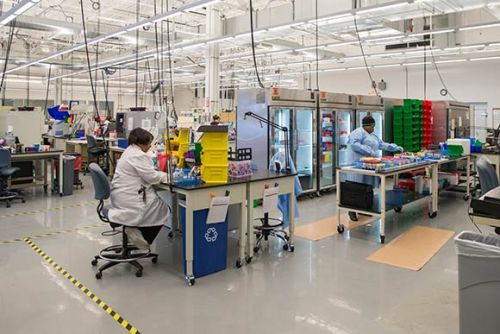
The Health-Tech Corridor was once a forgotten stretch of Euclid Avenue. Today the three-mile stretch between downtown and University Circle has become a hub of growing biotech and startup companies, with another round of development on the way.

Small Box, the innovative shipping container retail cluster in the Warehouse District, has announced its newest tenant: Blue Edge, a collaboration between Edge Hair Studio and Blue Envelope that will offer "eco-conscious and high-end gift and beauty products."
Edge Hair Studio and Blue Envelope are both located in downtown Willoughby. According to the release, "Edge Hair Studio is a full-service, eco-conscious hair and nail salon ... Edge is the only studio on the east side of Cleveland to carry the full line of exclusive Davines products. These products, handmade by a dedicated, passionate family in Parma, Italy, have a cult-following for the luxury they provide in a beauty routine. Every item is handwrapped by an in-house artist."
Blue Envelope is a three-year-old stationery studio. The firm specializes in customized stationery and sells "exclusive and some locally-designed stationery and gift brands" at their current location.
Both tenants have been active in growing the downtown Willoughby business scene. The release notes, "Historic Warehouse District Development Corp. welcomes with excitement Blue Edge as this group of creative and community-minded business owners make their first foray into Downtown Cleveland."
Edge Hair Studio and Blue Envelope are both located in downtown Willoughby. According to the release, "Edge Hair Studio is a full-service, eco-conscious hair and nail salon ... Edge is the only studio on the east side of Cleveland to carry the full line of exclusive Davines products. These products, handmade by a dedicated, passionate family in Parma, Italy, have a cult-following for the luxury they provide in a beauty routine. Every item is handwrapped by an in-house artist."
Blue Envelope is a three-year-old stationery studio. The firm specializes in customized stationery and sells "exclusive and some locally-designed stationery and gift brands" at their current location.
Both tenants have been active in growing the downtown Willoughby business scene. The release notes, "Historic Warehouse District Development Corp. welcomes with excitement Blue Edge as this group of creative and community-minded business owners make their first foray into Downtown Cleveland."

Eugene Malinskiy, founder of healthIT integrated solutions provider DragonID, didn’t even know a friend had nominated him for the 2015 Forbes.com 30 Under 30 in the manufacturing and industry category. And even though he was featured as one of the 30, Malinskiy just wants to focus on the work at hand.
“It’s nice to get recognized and nice to get the award, but we want to be left alone to do our work,” Malinskiy, 29, says. By work, he means a host of projects in everything from orthopedic and cardiac devices to pain treatments and wearable technology.
DragonID works on both their own ideas generated in-house and ideas brought to them from some of the area’s top people in healthcare. “We’ve done work with all the big boys in town – the Cleveland Clinic, University Hospitals,” Malinskiy boasts. “Physicians and others bring projects to us and say, ‘Hey, we have an idea for a product on a napkin, can you improve upon it?’ We follow down projects that we’ll hopefully be able to put into production.”
Most recently, DragonID developed a device that reduces the risk of stroke after aortic valve replacement surgery; this is the innovation that led to recognition by Forbes. The device is currently being tested. When it gets to production, Malinskiy plans to manufacture the product locally.
Founded out of LaunchHouse, DragonID now has offices in Cleveland Heights. Malinskiy credits his company’s success with the support he’s received from LaunchHouse, as well as from organizations like BioEnterprise, JumpStart and GLIDE.
Malinskiy credits DragonID’s success with the support that these organizations have provided, as well as having access to top physicians. “We sort of have our pick of the best projects,” he says, although he also prides himself on client confidentiality. “Of course it has to be related to medical, needs to pay and, obviously, needs to be interesting. As long as I know my team and I can do it, we’ll take it on.”
“It’s nice to get recognized and nice to get the award, but we want to be left alone to do our work,” Malinskiy, 29, says. By work, he means a host of projects in everything from orthopedic and cardiac devices to pain treatments and wearable technology.
DragonID works on both their own ideas generated in-house and ideas brought to them from some of the area’s top people in healthcare. “We’ve done work with all the big boys in town – the Cleveland Clinic, University Hospitals,” Malinskiy boasts. “Physicians and others bring projects to us and say, ‘Hey, we have an idea for a product on a napkin, can you improve upon it?’ We follow down projects that we’ll hopefully be able to put into production.”
Most recently, DragonID developed a device that reduces the risk of stroke after aortic valve replacement surgery; this is the innovation that led to recognition by Forbes. The device is currently being tested. When it gets to production, Malinskiy plans to manufacture the product locally.
Founded out of LaunchHouse, DragonID now has offices in Cleveland Heights. Malinskiy credits his company’s success with the support he’s received from LaunchHouse, as well as from organizations like BioEnterprise, JumpStart and GLIDE.
Malinskiy credits DragonID’s success with the support that these organizations have provided, as well as having access to top physicians. “We sort of have our pick of the best projects,” he says, although he also prides himself on client confidentiality. “Of course it has to be related to medical, needs to pay and, obviously, needs to be interesting. As long as I know my team and I can do it, we’ll take it on.”
